By Sharachchandra Bhandary
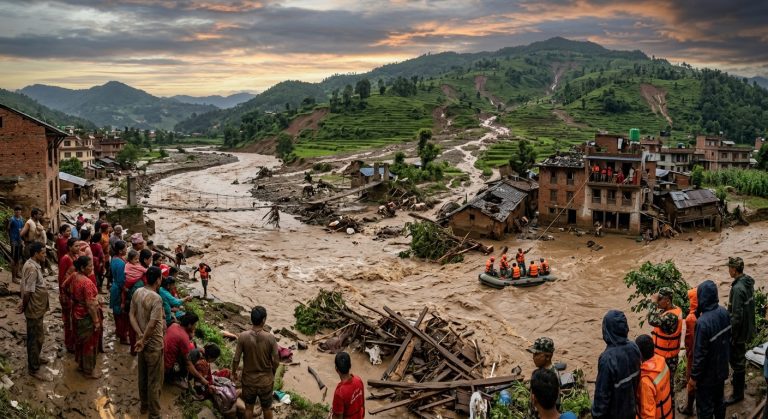
The devastating floods that struck the Bhotekoshi and Trishuli corridors on August 26 have left Nepal facing a painful question: how should a disaster of such magnitude be understood and responded to?
The first answer should be clear. Such disasters must be viewed scientifically, not politically.
Hundreds of lives have been lost, numerous families displaced and massive infrastructure destroyed. Roads, bridges, hydropower projects and other public and private assets have suffered severe damage. The government’s preliminary assessment has put the physical damage at around Rs 700 billion. But beyond counting the losses, Nepal needs to understand what actually happened, why it happened and whether similar disasters could occur again.
Those questions cannot be answered through political arguments or speculation. They require science.
Initial assessments have pointed to an ice avalanche and the temporary blockage of the Lhende River, followed by the sudden release of water and debris. But the complete chain of events needs to be established through careful scientific investigation. Geologists, hydrologists, glaciologists, meteorologists and other experts should examine the evidence before firm conclusions are drawn about the causes and contributing factors.
This is particularly important in the Himalayas, where the interaction of glaciers, rivers, steep terrain, rainfall and rising temperatures creates a complex and changing risk environment.
Nepal Academy of Science and Technology (NAST) Vice Chancellor Prof. Dr. Janardan Lamichhane says existing scientific studies show that the Earth’s temperature is rising and that warming in the lower regions can have even greater impacts in the high Himalayas. Studies by the International Centre for Integrated Mountain Development (ICIMOD) and the Intergovernmental Panel on Climate Change (IPCC) have established the growing vulnerability of the Himalayan region. The continued melting of glaciers and snow, together with the formation and possible outburst of glacial lakes, increases the risk of floods and landslides downstream.
Maheshwar Dhakal, Chief of the Climate Management Division at the Ministry of Forests and Environment, has similarly pointed to the growing risks, losses and damages Nepal is facing in the context of climate change. Rising temperatures in the high Himalayan region and increasing glacier-related risks, he says, demand stronger scientific understanding as well as a stronger international voice for Nepal on climate justice, climate finance and access to Loss and Damage funding.
These assessments do not mean that every individual flood or landslide can automatically be attributed to climate change. That distinction matters. Climate change is altering the broader risk environment, but the causes of a particular disaster must be established through evidence. That is precisely why scientific investigation should come before political claims.
The lesson from Bhotekoshi should therefore not simply be that Nepal needs more compensation after disasters. It should be that Nepal needs better knowledge before disasters occur.
The country needs stronger monitoring of glaciers and mountain lakes, reliable early-warning systems, better hydrological and meteorological data, safer infrastructure and stronger disaster-preparedness institutions. Scientific information must reach communities in vulnerable areas quickly enough to save lives. Infrastructure in high-risk valleys must be designed with changing environmental conditions in mind.
The need for scientific cooperation also extends beyond Nepal’s borders. Rivers, glaciers, weather systems and mountain hazards do not follow political boundaries. A flood originating in one part of the Himalayas can quickly affect communities downstream. Sharing data, developing cross-border early-warning systems and cooperating on mountain research should therefore be treated as practical necessities rather than diplomatic gestures.
Rabi Lamichhane, president of the ruling Rastriya Swatantra Party, made a similar point while addressing the Federal Parliament. He called for the Himalayas to receive international recognition as a region of particular climate and disaster risk and stressed the need for easier access to climate finance, scientific research and data sharing, cross-border early-warning systems and stronger international cooperation. Importantly, he also called for an independent scientific assessment before Nepal makes international claims regarding climate-related losses and damages.
That approach deserves attention. A credible scientific assessment strengthens Nepal’s case internationally; an unsupported political claim can weaken it.
Nepal is among the countries that have contributed relatively little to global greenhouse-gas emissions but remain highly vulnerable to the consequences of a changing climate. Its difficult geography, fragile mountain ecosystems and limited resources make recovery from repeated disasters especially difficult. Money that could otherwise go into development is repeatedly diverted to reconstruction and relief.
Professor Bipin Adhikari has argued that Nepal is dealing with a climate problem it did little to create. This brings into the discussion the principle of Common but Differentiated Responsibilities and Respective Capabilities, under which countries with greater historical responsibility for emissions and greater financial and technological capacity are expected to shoulder a larger share of the global climate burden.
That principle should not turn climate policy into a contest of accusations. Rather, it should encourage countries to work together according to their respective responsibilities and capacities.
For Nepal, international support should mean more than sympathy after a disaster. It should include investment in adaptation, scientific research, early-warning systems, resilient infrastructure, technology transfer and disaster preparedness. Where climate-related losses and damages exceed a vulnerable country’s capacity to cope, international mechanisms for Loss and Damage should be accessible, practical and responsive. For countries with limited fiscal space, grant-based assistance is often more appropriate than adding to their debt burden.
But international support cannot substitute for domestic responsibility. Nepal must improve its own systems for monitoring mountain hazards, enforcing safer construction standards, managing settlements in high-risk areas and coordinating disaster response. Reconstruction after Bhotekoshi should not simply replace what was destroyed. It should reduce the possibility of similar losses in the future.
There is also a danger in allowing every major disaster to become an immediate political contest. Governments should be held accountable when negligence, poor planning or institutional failure contributes to loss of life. But accountability should follow evidence. It should come through investigation, technical assessment and transparent decision-making, not through premature blame.
This distinction is important because science and accountability are not opposing ideas. Science tells us what happened and why. Good governance determines what should have been done and what must change. Politics should help turn that knowledge into action.
The upcoming COP31 in Antalya, Türkiye, also provides an opportunity to bring these concerns into the wider international climate discussion. For Nepal and other vulnerable mountain countries, the discussion should go beyond broad expressions of concern. Adaptation finance, Loss and Damage, mountain monitoring, early-warning systems, technology and international scientific cooperation need greater attention. The experience of disasters such as Bhotekoshi should remind the international community that climate vulnerability is not an abstract concept. It has real consequences for people, communities and economies.
Nepal, for its part, should approach such international forums with credible scientific evidence and clearly documented needs. The stronger the evidence, the stronger the country’s case for international support.
The Bhotekoshi disaster is a tragedy, but it can also become a turning point in how Nepal understands disasters. Instead of waiting for calamity and then debating responsibility, the country should invest in understanding risks before they become catastrophes.
And when a disaster crosses borders or exposes risks that no single country can manage alone, the response should not be a competition over who is to blame. It should be a search for knowledge, cooperation and solutions.
Nature does not recognize political boundaries. Neither should our efforts to protect human life.
When disaster strikes, science must lead the way. Politics has its place—but humanity must rise above it.